Starting the year with clarity: what homeowners say they need to make energy decisions


I’m starting the year thinking about energy decisions because that’s where so many homeowners are right now. Over the recent 2025 holiday period, repeated unplanned outages left well over 130,000 Bay Area households and businesses without power at times, with some neighborhoods in San Francisco dark for 48 hours or more as crews worked to restore service.
In the weeks since, dozens of smaller outages continued into New Year’s Eve, reminding families how real and immediate questions of energy reliability have become.
As policies shift, incentives change, and electrification solutions keep emerging, I’ve noticed a familiar pattern in conversations with families: uncertainty, mixed information, and a real lack of confidence in how to move forward.
That uncertainty doesn’t just slow people down. It often causes them to delay—or completely forgo—upgrades like solar panels, home batteries, heat pumps, and other electrification products.
Curious why, I turned to something simple and close to home. I surveyed 75 homeowners to understand how people actually make energy decisions at home today: who decides, what they value, and what gets in the way.
There’s a strong signal here, especially around women homeowners, pointing to a need for better education, clearer information, and more transparent conversations about energy. Not more jargon. Not more pressure. Just better tools to help people feel informed, prepared, and confident about their decisions.
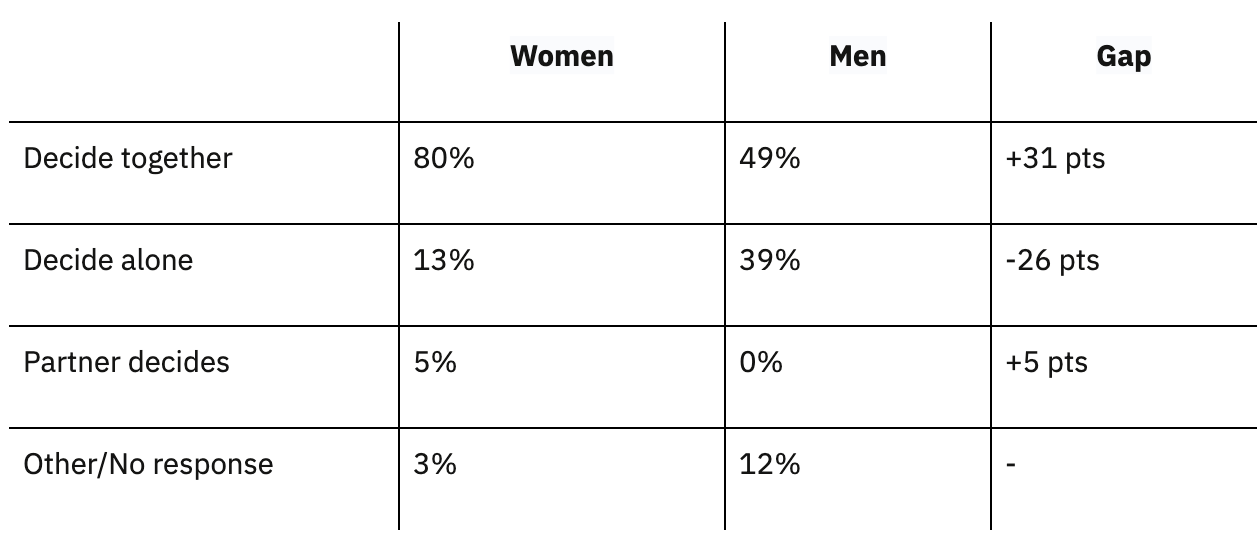
When it comes to energy decisions at home, most people don’t decide in isolation, but how that collaboration happens varies meaningfully.
Overall
By gender
When people think about investing in home energy, the “why” matters just as much as the “what.”
Top motivations overall
Where motivations diverge
By gender:
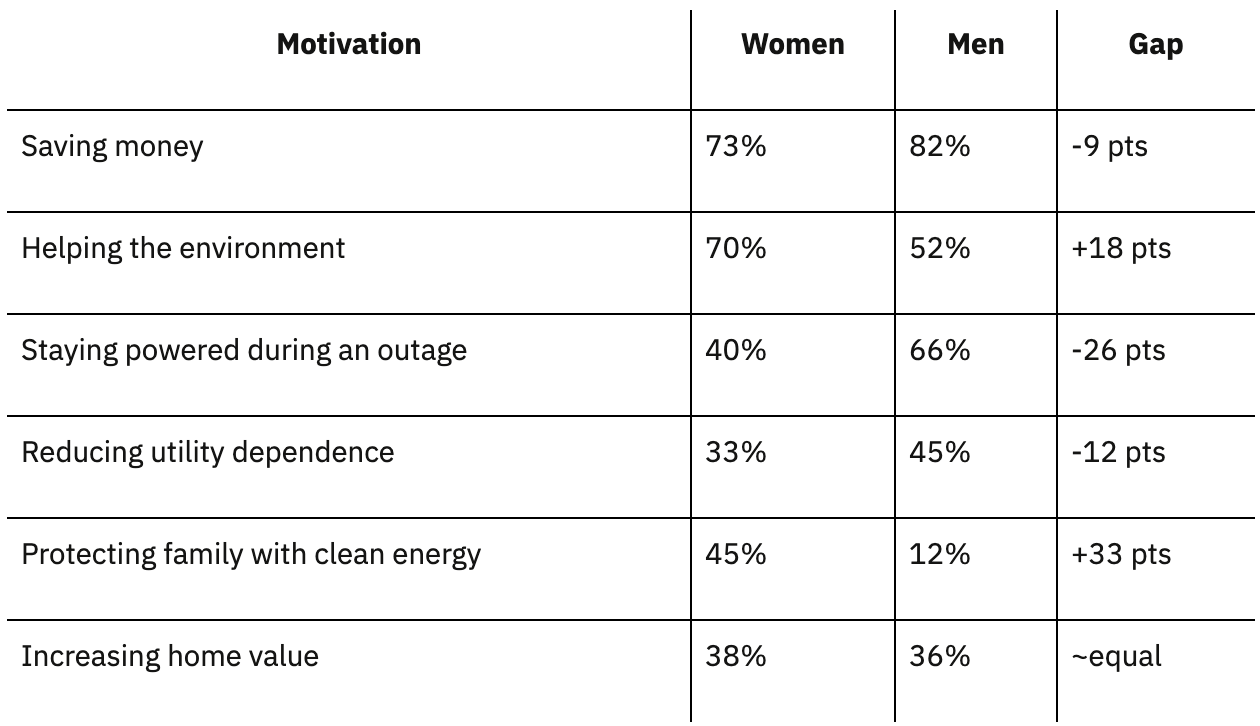
These differences aren’t contradictions, they’re complementary. And they suggest that effective energy conversations need to acknowledge both emotional and practical drivers.
I also asked a simpler, more human question: Which feeling matters most to you when it comes to energy in your home?
Women's top 3:
Men's top 3:
The insight: Control is universal. But what “control” means varies. For some, it’s visibility and pride. For others, it’s resilience and protection. Both are valid.
If energy decisions feel hard, it’s not because people aren’t capable, it’s because the process often is.
The quotes tell the story clearly: too many answers, not enough clarity, and not enough trust.
When asked what would help them move forward, homeowners were remarkably consistent:
The insight: Confidence isn’t about education level or income. It’s about access to information that’s clear and credible.
A few observations stand out:
This is a small, exploratory snapshot, not a final answer. What I’m doing next is simple: listening more, sharing more, and building resources that help homeowners feel informed and empowered. Especially women, who are already doing so much of the invisible work of decision-making at home.
If we can make energy feel clearer, more human, and more trustworthy, we’re on the right path.