Our simulator tool identified Arizona and Illinois as attractive markets, showing ~35% extra savings from Lunar AI
Every market is different. Rates, tariffs, and programs vary from state to state, and so does the value of solar and a battery for your customers.
Now you can test that value before you commit. We developed a new simulator tool in the Gridshare platform that runs a year of home data through a market’s rate plans. You can adjust the inputs, such as the amount of solar, the size of the battery, or the rate plan, to model different customer and business scenarios. The tool then quantifies what Lunar AI adds in savings on top. It uses the home’s actual usage, not an average profile, so you can see which offers will work best for your customers and where to focus.
Here are two markets we’ve already run.
We set out to answer two questions for Arizona homeowners: 1) How much can solar, a battery, and Lunar AI save them? And 2) which Arizona Public Service (APS) rate plan saves the most? The choice is between TOU-E, a standard time-of-use rate, and R-3, which offers cheaper energy but adds a monthly charge based on a home’s single highest hour of peak usage.
We ran a year of actual energy data from 25 Arizona homes through the simulator. We modeled each home four ways: no solar or battery, solar only, solar with a 20 kWh battery in self-consumption mode, and the same system running on Lunar AI. Each setup ran on both tariffs.
Here’s what we found:
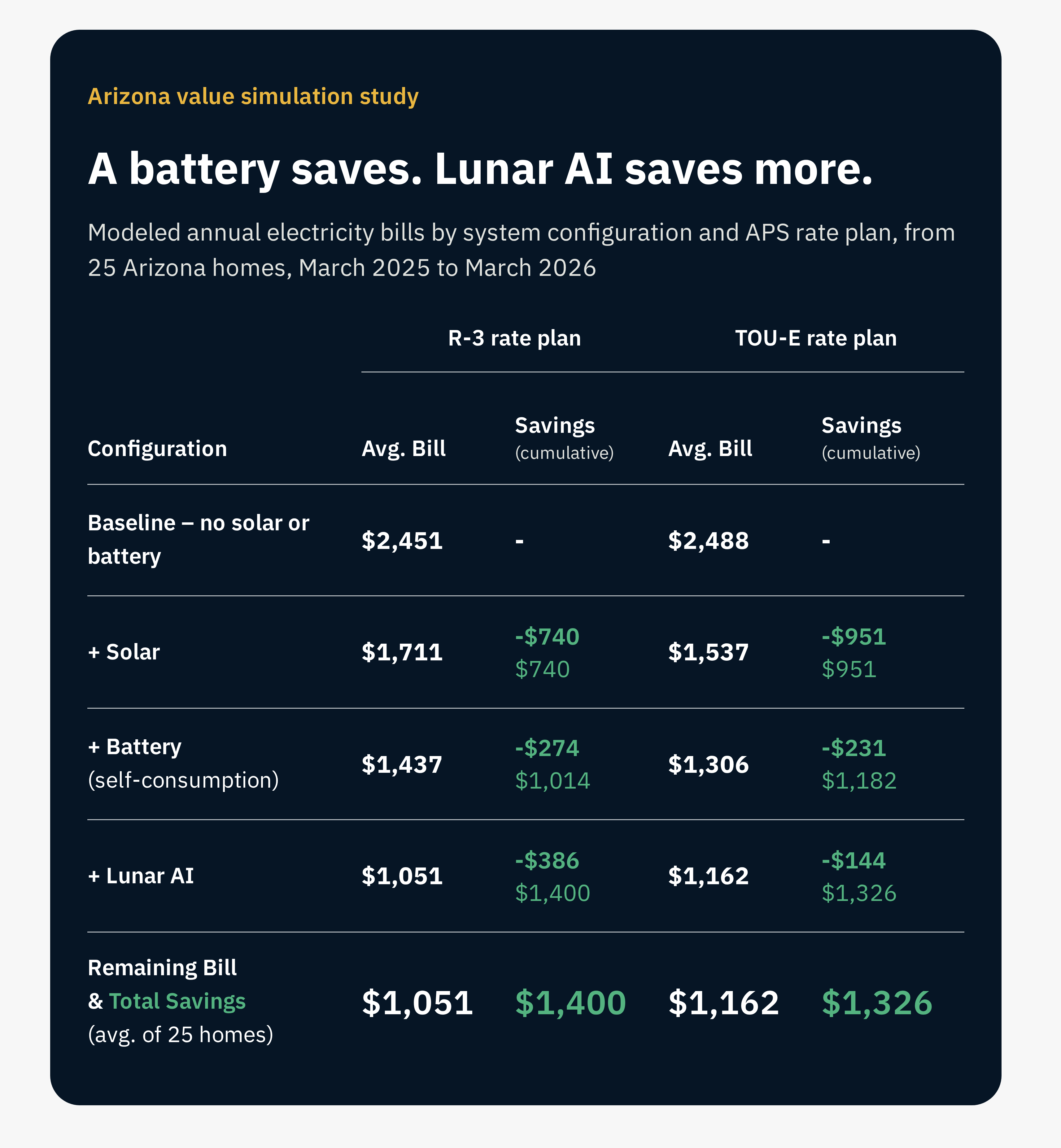
Our new simulation tool in Gridshare shows where your customers can save the most. Lunar AI then handles the complexity of capturing those savings.
ComEd, the utility serving northern Illinois including Chicago, offers hourly rate plans that follow real-time wholesale prices. The two options are BESH with a flat distribution charge and BESH TOUD with a time-of-use distribution charge. Both also add a monthly capacity charge tied to a home’s usage during the grid’s five peak hours of the previous year.
To find out which option offers more value, we put a full year of actual data from 9 Illinois homes through the simulator. Each home was modeled in the same four ways as Arizona, except that homes without solar or a battery were assumed to be on Basic Electric Service (BES). Because BESH TOUD produced the lowest bills among the BESH plans, the results below are shown for that plan.
The results:
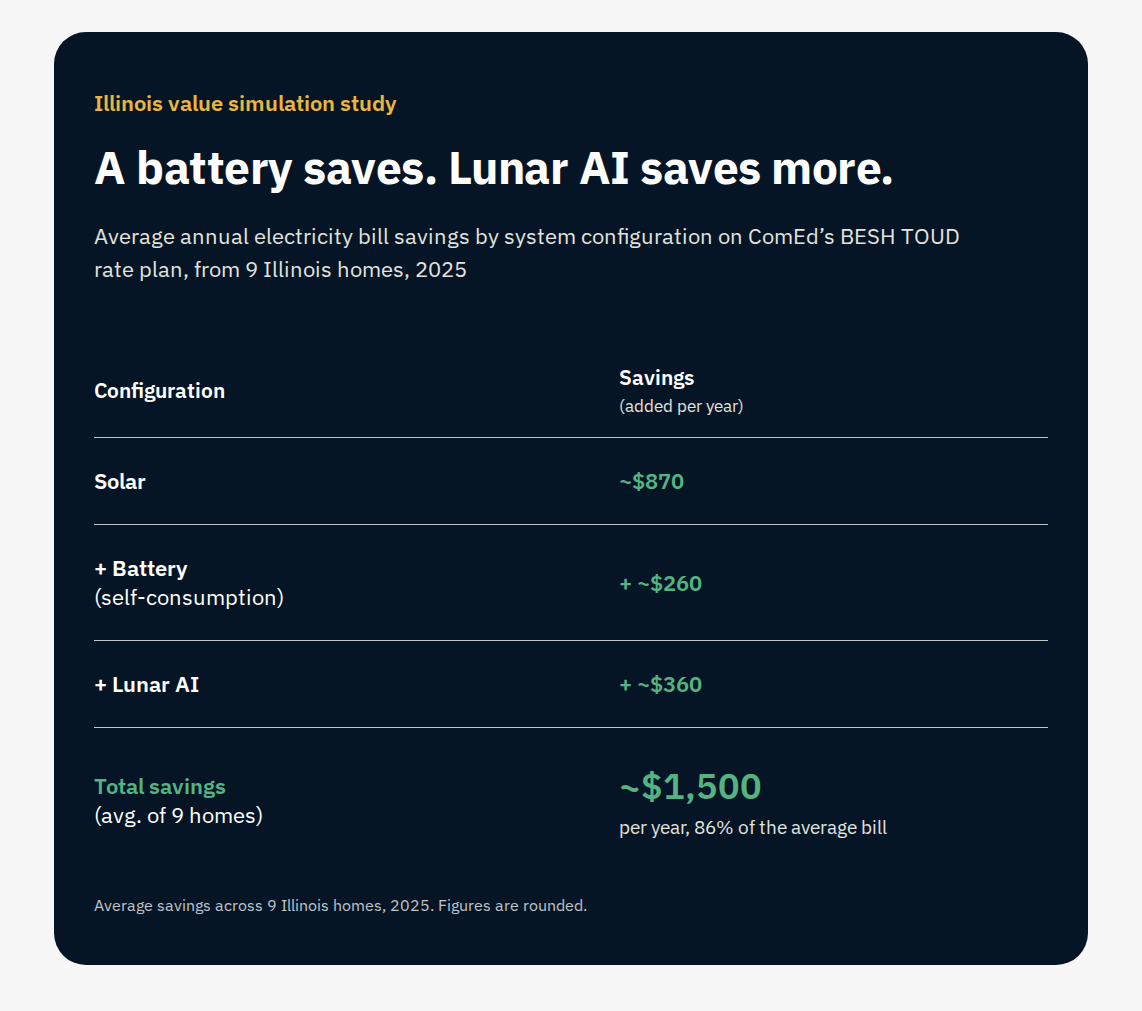
Lunar is already commercially active in Illinois, deploying Lunar Systems and delivering savings to homeowners today.
Across both Arizona and Illinois, the simulator shows the same pattern: Lunar AI generates added value on top of solar and a self-consumption battery. In both markets, it also lifted results for the homes that saved the least.
We’ve demonstrated that Lunar AI delivers measurable extra value in markets with very different rate structures, and that value is clearest where the tariffs are most complex.
The more complex the rate plan, the more Lunar AI adds. It plans each home’s battery every day, so savings don’t depend on customers cutting their own peak use. Lunar AI does that for them.
See how Lunar AI increased savings for our California customers in August.
Curious what solar and battery are worth in your territory, and the extra value Lunar AI brings on top? Talk to our team and try our new value simulation tool.